Research analytics: the ontology
The same approach as the credit domain: classes, a property for each CSV column, and every code as a SKOS concept with a plain-English definition. The local rules are stated there and nowhere else. Each file links to its source on GitHub:
ontology.ttl: the definitions, as SKOS in Turtle.ontology.md: the same definitions as Markdown, generated from the Turtle byontology_to_md.py. This is what R4csv+markdowngets, and it's shown below.padding.md: the decoy glossary for R3csv+padding. It's on the same subject, scholarly publishing, and as long asontology.md, but defines none of the terms the questions depend on.axioms.ttl: the meaning as logic, for R8csv+axiomsand D6sparql+axioms. OWL axioms define a research work, key authors by their ORCID and set out the classes. SHACL rules derive what the prose only says: the records of one person, the work a preprint counts as, the institution credited for each person on each work, the hierarchy up to its top (stopping at affiliated institutes), and the citations that count.check_axioms.pyruns the rules and checks that everything they derive agrees with the answer keys.
The ontology at a glance
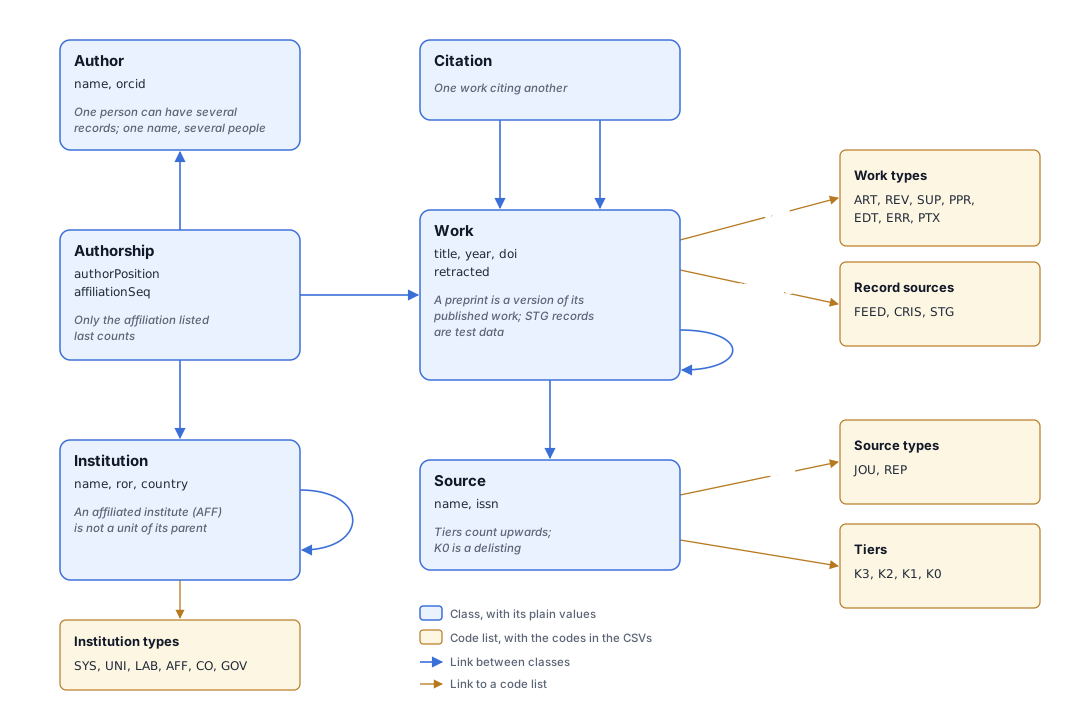
A sketch, drawn by hand from the definitions: the classes, the links between them, and the code lists they use.
The definitions, as the R4 csv+markdown condition gets them
Research analytics: a teaching ontology
Works, authors, institutions, sources, authorships, citations and the codes the data uses, each with a definition that states what it means and how to count it. Invented for an experiment; not a model of any real bibliographic database.
Classes
Work
A record of something published: an article, review, preprint, editorial, erratum or piece of paratext (work type). Not every work is research output. A research work is a work that (1) is not a test record (see Staging (STG)), (2) is of a research type: an article (ART), a review (REV), a supplement article (SUP) or a preprint (PPR), (3) is not retracted (retracted), and (4) did not appear in a delisted source (Delisted (K0)). Editorials, errata and paratext are never research output. A preprint and its published version (version of) are two records of one research work and count once, under the published version (its year and its source). Every count of works means research works, and citations are counted to research works, unless a question says otherwise.
Author
An author record: one person as one source spelled them. A person is identified by their ORCID (ORCID), not by their name or record ID. The same person can appear as several author records with differently spelled names: records with the same ORCID are the same person, and every work recorded against any of them is that person's. Two records with the same name and different ORCIDs are different people. A record with no ORCID is a person of its own.
Institution
An organisation that authors are affiliated with: a university system, university, lab, company, government body or affiliated institute (institution type). Institutions form a hierarchy through parent: a lab can sit under a centre, under a university, under a university system. A work credited to a unit is also credited to every institution above it, to any depth, so counting an institution's works means counting the works of the institution and all its units, each work once. The exception is an affiliated institute (Affiliated institute (AFF)): its parent link does not make it a unit.
Source
Where a work appeared: a journal or a repository (source type).
Authorship
One author's place on one work, and one of the institutions they gave for it: one record per author, work and affiliation. An author who gave two affiliations on a work has two authorship records for it, with the same author position and different affiliation sequence. Which one counts is set by affiliation sequence.
Citation
One work citing another: citing work lists cited work among its references. A citation happens in the citing work's year. A work's citation count is the number of distinct works, of any type, that cite it, leaving out test records (Staging (STG)) and retracted works. A work citing both a preprint and its published version is one citation of that research work. Citation counts for an author, institution or country add up the counts of their research works. When citations are rolled up to the citing side (which institution or country cites another most), each citing work counts once for each institution credited on it, however many of its authors are from that institution. A self-citation depends on the level: an author self-citation is one where the citing and cited works share at least one author (the same person, whatever the record); an institution self-citation is one where they share a credited institution at the level asked about; a country self-citation is one where they share a country of credited institutions. Each level includes the one below it, so the three are different counts. A citation window counts only the citations made in the cited work's publication year and a given number of years after it, so that older and newer works are compared over the same span.
Properties
name (CSV column name)
The name of an institution, author or source as the record spells it. Names are not identifiers: the same person can be spelled differently, and different people can share a name.
ROR ID (CSV column ror)
The institution's Research Organization Registry identifier (invented here).
country (CSV column country)
ISO code of the country where the institution is. A work's countries are the countries of the institutions credited on it (see affiliation sequence), not of every affiliation listed.
institution type (CSV column type)
What kind of institution it is: a concept of the scheme Institution types.
parent (CSV column parent_id)
The institution this one is a unit of. Follow it upwards, to any depth, to find the institutions a work is also credited to; the ultimate parent is the institution at the top of the chain, the one with no parent. For an affiliated institute (Affiliated institute (AFF)) the link records an agreement, not membership: do not follow it.
ORCID (CSV column orcid)
The person's ORCID identifier (invented here): the identifier that says which person an author record stands for. Same ORCID, same person.
ISSN (CSV column issn)
The journal's ISSN (invented here). Repositories have none.
source type (CSV column type)
Whether the source is a journal or a repository: a concept of the scheme Source types.
tier (CSV column tier)
The source's tier on this dataset's own journal list: a concept of the scheme Journal tiers. The tiers count upwards: K3 is the highest tier and K1 the lowest; K0 is not a tier but a delisting. Repositories have no tier.
title (CSV column title)
The work's title. A preprint and its published version often share a title; two works with the same title are not the same work unless version of links them.
publication year (CSV column year)
The year the work was published. A citation's year is the citing work's publication year.
work type (CSV column type)
What kind of work it is: a concept of the scheme Work types. It decides whether the work is research output (see Work).
source (CSV column source_id)
The journal or repository the work appeared in.
DOI (CSV column doi)
The work's DOI (invented here). A preprint and its published version have different DOIs, though they are one research work.
version of (CSV column version_of)
Set on a preprint whose published version is also in the data: it names that published version. The two records are one research work, counted once, under the published version; the authors, institutions and citations of either record belong to that one work.
retracted (CSV column is_retracted)
True if the work has been retracted. A retracted work is not research output: leave it out of every count of works, and its citations out of every count of citations.
record source (CSV column record_source)
The system the work record was loaded from: a concept of the scheme Record sources.
work (CSV column work_id)
The work the authorship is on.
author (CSV column author_id)
The author record: see Author for which person it stands for.
author position (CSV column author_position)
The author's place in the byline, from 1. The number of a work's authors is the number of distinct people in its byline.
institution (CSV column institution_id)
An institution the author gave on this work.
affiliation sequence (CSV column affil_seq)
The order in which the author listed their affiliations on this work, from 1. House rule: when an author lists several affiliations on one work, the work is credited only to the affiliation listed last, the one with the highest sequence number, for that author; the others are ignored in every count. With one affiliation, that one is credited. Under full counting, a work counts once for each institution credited on it (and for the institutions above it). Under fractional counting, a work is split equally among its authors (distinct people), and each author's share goes to the one institution credited for them, and so to its country; an institution's fractional count adds up the shares of its own authors and its units' authors.
citing work (CSV column citing_work_id)
The work that makes the citation.
cited work (CSV column cited_work_id)
The work that is cited.
Codes
The codes as they appear in the data, grouped by list.
Work types
- ART, Research article: A peer-reviewed research article. Research output.
- REV, Review article: A peer-reviewed article that surveys a field. Research output.
- SUP, Supplement article: In this dataset, SUP does not mean supplementary material. It is a full, peer-reviewed research article published in a supplement issue of a journal, such as a proceedings supplement. It is research output and counts exactly like an article (ART).
- PPR, Preprint: A version posted to a repository before or without peer review. Research output, but if its published version is in the data (version of), the two are one research work, counted once.
- EDT, Editorial: An editor's introduction or opinion piece. Not research output.
- ERR, Erratum: A correction notice for an earlier work. Not research output, and not a new version of the work it corrects.
- PTX, Paratext: Front matter, issue information, tables of contents and the like: published with a journal issue, but not a contribution. Not research output.
Institution types
- SYS, University system: A group of universities under one governing body. Its works are the works of all its universities and their units.
- UNI, University: A university or college.
- LAB, Laboratory, centre or institute: A research unit inside its parent institution. Its works are also its parent's works, and its parent's parent's, to the top.
- AFF, Affiliated institute: A legally independent institute linked to a university by an agreement. Its parent link records that agreement and nothing more: an affiliated institute is not a unit of its parent, is not part of the parent's system, and its works are never credited to the parent or to anything above it. Its ultimate parent is itself.
- CO, Company: A company.
- GOV, Government body: A government agency or laboratory.
Source types
- JOU, Journal: A peer-reviewed journal, including its proceedings or supplement issues.
- REP, Repository: A preprint server or other repository.
Journal tiers
- K3, Tier K3, the highest: The highest tier: the journals the list ranks first. A higher number is a higher tier, so K3 ranks above K2, and K2 above K1.
- K2, Tier K2, the middle: The middle tier: below K3, above K1.
- K1, Tier K1, the lowest: The lowest tier that is still listed: below K2.
- K0, Delisted source: Not a tier: a source removed from the list for failing its review of editorial practice. Works that appeared in a K0 source are not research output, whatever their type, and are left out of every count of works and citations.
Record sources
- FEED, Bibliographic feed: Loaded from the external bibliographic feed.
- CRIS, Institutional research information system: Entered by an institution in its own research information system. As good as a feed record.
- STG, Staging load: Test records, loaded into staging to check the import and never removed. They describe no real work: ignore an STG work, its authorships and every citation it makes, in every count.